
Apr 26, 2012 | #1
Nelson Mandela - Great Statesman Research
Nelson Mandela is a great statesman famous for his fight against apartheid in South Africa. Viewed through the lens of that struggle, his adult life can be viewed as consisting of three main stages. The first of these consists of his peaceful attempts to oppose racist laws, and his eventual surrender to the temptation to use violence. The second stage consists of his life in prison after his capture by South African authorities. The third and final stage consists of his life after his release from prison, when he helped to negotiate a peaceful transition to South African democracy. In Mandela's progress from peaceful protester, to violent rebel, to government captive, and back again to a man of peace, we see how a hero was forged.
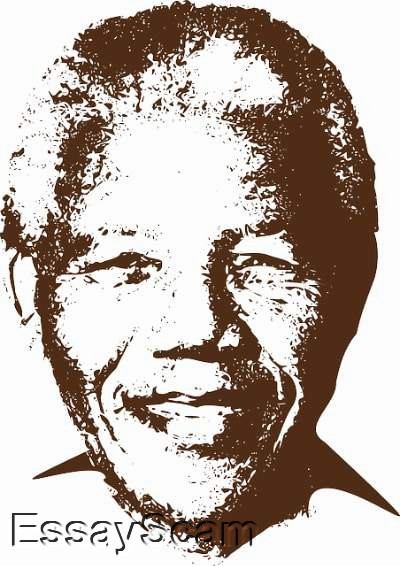 Born in 1918, Nelson Mandela had a fairly unremarkable childhood. Although born to a family that was old African royalty, as his "great-grandfather was . . . the Inkosi Enkhulu or King of the Thembu people," (Wikipedia) he was never in danger of inheriting any important political positions. Instead, he grew up on a farm, where his time was spent "spent on cattle herding and other rural pursuits" (Brink). He went to school, which was a remarkable fact only in that he was the first in his family to do so. He did well enough to get into university, and seemed likely to live a fairly ordinary life. Around the time he turned nineteen, he "ran way from his guardian to avoid an arranged marriage" (Brink), and ended up an apprentice in a law firm. It was during his apprenticeship that he first began to chafe at the injustices of the racist system of the South African government, under which system he found his own humanity constantly denied by the authorities.
During the Second World War, Mandela joined with other members of the fledgling ANC. "These young people set themselves the formidable task of transforming the ANC into a mass movement, deriving its strength and motivation from the unlettered millions of working people in the towns and countryside, the peasants in the rural areas and the professionals." (ANC). He hoped that with enough popular support, the ANC would be able to prevent the all-white National Party, who at that time was gaining ground in the polls, from implementing their policies of apartheid. When the National Party was elected in 1928, it promptly segregated blacks and whites anyway, and legislated many racist laws that ensure blacks would receive service much inferior to that reserved for whites.
At first, Mandela, whose "approach [to civil protest] was influenced by Mahatma Gandhi" (Wikipedia), chose to engage wholly in nonviolent protest. This lasted for thirteen years, until the government decided it had had enough negative publicity over its policies generated by the ANC, and banned it and all other anti-apartheid groups. With all meaningful opposition parties outlawed, and events such as the Sharpeville massacre occurring all too frequently, it had become obvious to Mandela that peaceful protest had failed: "It was during this time that he, together with other leaders of the ANC constituted a new specialized section of the liberation movement, Umkhonto we Sizwe, as an armed nucleus with a view to preparing for armed struggle." (ANC). Given Mandela's iconic status as a freedom-fighter and defender of the principles of liberty and equality, many do not like to remember that his participation in the armed branch of the ANC often included involvement in terrorist activities, with civilians being targeted as well as government installations. Mandela himself, however, has never attempted to deny this or to cover it up. On the contrary, "Mandela . . . [has] admitted that the ANC, in its struggle against apartheid, also violated human rights, and has sharply criticized attempts by parts of his party to remove statements supporting this fact from the reports of the Truth and Reconciliation Commission" (Wikipedia). His willingness to admit the wrongs done in a long, bitter, racially charged conflict by his own side can be seen as affirming his personal commitment to genuine justice.
Mandela waged his guerilla campaign for almost two years before finally being captured by the authorities in 1962. Mandela's imprisonment at that time has often been viewed as an injustice. In fact, he was actually guilty of many the crimes for which he was sentenced, which violated perfectly reasonable laws unconnected to those of apartheid: "Charges included involvement in planning armed action, in particular four charges of sabotage, which Mandela admitted to, and a conspiracy to help other countries invade South Africa, which Mandela denied" (Wikipedia). Mandela was likely telling the truth on both counts - while he had not plotted to help other nations overthrow the South African government, he had carried out violent acts of sabotage on South African soil. However, most believed his claims that his unlawful, violent deeds were justified as a form of political protest against the manifestly unreasonable laws of apartheid. In other words, they agreed with Mandela's assertion at the time that "It was only when all else had failed, when all channels of peaceful protest had been barred to us, that the decision was made to embark on violent forms of political struggle, and to form Umkhonto we Sizwe...the Government had left us no other choice" (ANC). Many political observers also realized that Mandela had become a symbol of black resistance to white oppression in South Africa. His status as such a symbol meant that he was ideally suited to leading negotiations for peaceful political change.
Thus began twenty seven long years of imprisonment. Jail time is hard for any convict, but it was especially grueling for Mandela, as he was considered doubly low on the totem pole, as both a black prisoner and a political one. Like many prisoners in South Africa, Mandela was forced to perform heavy manual labor in a "limestone quarry [whose glare] permanently impaired Mandela's vision" (Brink) Given these conditions, most men would have broken, as indeed many other political prisoners did, regardless of race. Yet Mandela not only stood up to this treatment, but also made the prison in which he found himself a better place: "His major response to the indignities of the prison was a creative denial of victimhood, expressed most remarkably by a system of self-education, which earned the prison the appellation of 'Island University.'" (Brink). He not only improved his own mind by studying whenever he could, he improved the minds of his fellow inmates by teaching them whatever he could with the materials he had to hand.
In his early struggle against apartheid, first peacefully, and then by force, Mandela was but one of many organizers, many protestors. If he had been distinguished by anything, it was his attitude, one of confidence and dignity that could not be shaken or diminished by anything his opponents could think of. It was because of this confidence and dignity, which he continued to hold despite being reduced to the lowest type of prisoner throughout his stay in jail, which turned him from a confessed terrorist into a heroic freedom fighter in the eyes of the international press. This in turn led to his rise as a symbol of black oppression. However, it was his actions after he was released from jail that truly established him as a great man, for it was then that he began the process of negotiating a peaceful transition from a racialist tyranny to an egalitarian democracy. And in this process, Mandela had to battle not one, but three separate foes: the white power structure, the concerns of white citizens, and his own black followers.
Ironically, the white power structure at that time was actually the easiest of his opponents to overcome. Shortly before Mandela's 1990 release, then South African president De Klerk had already "unbanned the ANC and other anti-apartheid organizations" (Wikipedia). While the relationship between the white government and the black ANC continued to be strained, periodic outbreaks of violence had made clear to everyone that the alternative to a negotiated transition to democracy was a degeneration of South African society into a state of bloody civil war. Mandela knew that neither blacks or whites would win in such a conflict. The black population would have the advantage of overwhelming numbers, but the white military machine would be much better trained and equipped. The only result could be wholesale slaughter of both black and white alike. Just as bad, from Mandela's point of view as a defender of democracy, whoever emerged victorious from such a conflict would likely be a brutal despot intent on maintaining apartheid. A black leader would simply mean large scale oppression of whites, while a white leader would mean a hardening of racialist attitudes that would take a generation to overcome. To avoid this outcome, both the government and the ANC wanted to find a way to implement peaceful change.
A greater barrier to change was "the process of allaying white fears" (Brink). While the white politicians had come to realize that a shift in power was inevitable, they feared that the rise of the ANC would be followed by bloody retribution for the wrongs of apartheid. Mandela realized that if he wanted change to occur peacefully, he would have to allay those fears. Otherwise, the whites would cling to power with their last breaths, and armed conflict would become inevitable. As a result, he shifted his rhetoric, emphasizing the need for negotiation and healing, rather than for violence and reckonings.
Finally, Mandela faced opposition from within the ranks of his own ostensible supporters: "Every inch of the way, Mandela had to win the support of his own followers" (Brink). Many still distrusted the white government, and believed that peaceful negotiations still would not bear fruit. Others wanted exactly what the whites in South Africa feared they did - a chance to settle old scores. However, he knew that democracy and the rule of law were paramount if South Africa were to succeed. He also knew that if South Africa collapsed into chaos after the fall of apartheid, then many whites would believe that it had been justified, and that black people were not capable of civilized self-government. To avoid this, once he had become president in the countries first democratic elections, "Mandela presided over the transition from minority rule and apartheid, winning international respect for his advocacy of national and international reconciliation" (Wikipedia). Instead of hunting down and punishing those who had committed atrocities under apartheid, he offered amnesty to all those who were willing to confess to them. In that way, he both exposed the horrors of apartheid and prevented the desire for retribution from plunging the nation into civil conflict.
Mandela received the Nobel Peace Prize in 1993, as well as "more than one hundred [other] awards over four decades" (Wikipedia). These awards reflect not only his efforts on behalf of the South African people, but also his attempts to influence international events. He has advocated more funding to help solve the global AIDS crisis, opposed Bush on the Iraq war, and established himself as a staunch supporter of the United Nations. Nevertheless, he remains best known for his struggle against the racism and injustice of apartheid. Given the way he negotiated a peaceful transition to democracy in a country with such a divisive and bitter history, it is easy to agree that "the patience, the wisdom, the visionary quality Mandela brought to his struggle, and above all the moral integrity with which he set about to unify a divided people," make him a true hero (Brink).
Works Cited
Brink, Andre. "Nelson Mandela." Time Magazine.
"Nelson Mandela." Wikipedia.
"Profile of Nelson Rolihlahla Mandela"