The owner of
x-all.cc and
vua.tel ordered an essay using a stolen credit card. Beware of the fraudster.
-----------------
Abstract
This paper covers statistics for traffic accidents in the Philippines and suggestions that can be implemented in order to reduce traffic accidents in the country as a whole. Driver error and mechanical failure are the dominant issue types when it comes to the causes of accidents, and several suggestions including increased regulations, manufacturing standards and driver's education could combat these accident causes.Transportation in the Philippines
Travelling in the Philippines can be dangerous, for a variety of reasons. According to the Philippine government on the National Statistic Coordination Board website, this country averages approximately 41 traffic accidents per day, which is down from 43 accidents per day in 2003. Most of these accidents are caused by errors that drivers make (approximately 28% of accidents occurring from driver error) and the next highest cause of traffic accidents is vehicle mechanical defect (approximately 16%) (NSCB 2007). The following table is from the NSCB website (2007) and shows the causes of accidents in the Philippines from 2001 to the last statistical count in 2006.
As of 2006, 674 traffic fatalities occur every year, which is a slight rise over the initial numbers in 2001 (NSCB 2007). Non-fatal accidents involving property damage have been decreasing. This is an interesting note, as automobiles are the most commonly used vehicle in automobile crashed, but motorcycles and the Filipino Jeepney are close in numbers (NSCB 2007).
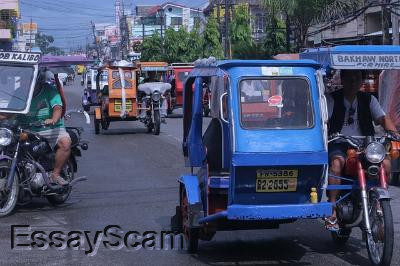
The Jeepney is a vehicle that is popular in the Philippines. Used as a very common and inexpensive mode of transportation, these unique vehicles were originally said to have been crafted from the popular Willy's Jeep, with some major constructive and creative adaptations. "Jeepneys don't have air-conditioning. They have open windows. Most of the time the Jeepneys are constantly packed with many passengers. " They seldom have a special place to stop. The drivers will slow down enough to enable the passengers to jump on or out" (Frysinger 2009).
Another common mode of transportation in the Philippines is the "tri-cycle". In American terminology, this is thought of as a child's toy, a small, three-wheeled pedal bike that young children ride before they learn to ride two wheeled bikes. In the Philippines, however, a tri-cycle can be a motorized form of transportation with engines from 50cc to 125cc; these tri-cycles are used mainly for public transportation (Neele 2009). Motorcycle taxis are similar to the tri-cycle; however, these only have two wheels. The alarming thing about motorcycle taxis is that they will carry up to four people at a time on a traditional two-seater motorcycle.
Considering these two modes of transportation in the Philippines alone, several suggestions can be made for the reduction of traffic fatalities and accidents. The Jeepney, obviously, can be considered a safety hazard for the general public. First of all, these vehicles construction is dubious, at best, and at the worst, a downright hazard. According to Frysinger, the very first Jeepneys were made from the old American Willy's Jeep (no longer manufactured in the United States). The Jeepneys were then cut apart, and extended to make them longer, with room for more passengers (extending them an estimated six feet in length). The design of these "enhancements" was created in order to make these a bus-like vehicle, to maximize passenger loads and profit. Later, there were some manufacturers of the Jeepney in the Philippines, but the last of these companies went out of business in 2001 (2009).
New parts are not available for these vehicles, and as they age, obviously, they are facing mechanical failure. The statistics show (mentioned above) that mechanical defect is the second highest cause for traffic accidents in this country. With accidents being caused by mechanical defect, the implementation of vehicle safety inspections as well as improvement to parts and accessories, such as tires and even steering mechanisms could help to reduce mechanical failure (Lee 1986, p 37).
Creating more vehicle inspection stations and having these inspections cover a wider range of possible mechanical issues could help reduce the number of mechanically related traffic accidents. The Philippines currently does not focus on vehicle safety inspections, according to Dr. Crispin E.D.Diaz, Affiliate Assistant Professor at the National Center for Transportation Studies in the University of the Philippines " Dilman. According to Dr. Diaz, the Philippines has a decided lack of interest in vehicle safety, because the "Motor vehicle inspection in the Philippines focused mainly on the provision of basic safety devices such as headlights and blinkers. But operational performance " [is] not [one of the] the main concerns. Until early 2001, only 4 Motor Vehicle Inspection Systems (MVIS) were operational the Philippines which were fitted to cover a wider range of performance tests" (p 3).
Another way to improve traffic accidents may be to begin regulation of the public transportation system. This can be a two-part undertaking. First, the regulation of the construction of the public (and private) transportation system can be implemented. In the United States, there are regulations that guide the manufacture and construction of vehicles, which make vehicles safer and less prone to mechanical defect. These regulations, some of which can be found at gpo.gov/fdsys/pkg/CFR-2001-title49-vol1/content-detail.html are guidelines and rules about the construction of vehicles and things that vehicles must have in order to pass safety regulations. Since many of the Jeepneys in the Philippines are "hand-made" (Frysinger 2009), it's doubtful that any regulations are followed. Making these vehicles safer could result in fewer accidents and casualties.
Another regulation of the public transportation system that could be implemented is a regulation on passenger numbers and passenger entrance and exit to and from vehicles. According to Neele (2009) motorcycles in the Filipino public transportation system can at times carry up to four passengers. Reducing the number of passengers that these modes of transportation are able to carry may improve safety. Traditional motorcycle seating is only able to seat two people, without a sidecar or other adaptation. The Jeepneys can be required to provide safety belts for passengers, and may be required to only transport the number of passengers that is equal to the number of seatbelts, which will reduce over-crowding. In the United States, the implementation of safety belt laws has reduced the number of fatalities exponentially. The graph below (courtesy of the US Department of Transportation) shows how traffic fatalities decrease as seatbelt usage increases. In addition, "Seat belt use continued to be higher in the States in which vehicle occupants can be pulled over solely for not using seat belts" (US Department of Transportation 2011, p 1), which makes a case for law enforcement being able to pull vehicles over for seatbelt violations instead of having to couple that with an additional violation.
The number one cause of traffic accidents, driver error, can be reduced by increasing driver education, and offering or requiring traffic school for traffic offenders. New requirements for driving school could be longer educational courses and defensive driving techniques. Heavier fines for traffic violations could also decrease speed and repeat offenses.
In conclusion, there are several recommendations that can be made to decrease traffic accidents in the Philippines. Three things can be done are to regulate vehicle construction, increase driver education and create public transportation regulations for the number of passengers that are allowed to ride in specific vehicles. Each of these ideas can help to reduce traffic fatalities and accidents alone, but coupled with one another; a greater decrease should be expected in traffic accidents in the Philippines.
ReferencesDiaz, Crispin. UNK. "Environmental Policy and Road Transportation in the Philippines.'
Frysinger, Galen R. 2009. "Jeepneys'
Lee, Kang. 1986. "An Analysis of Automobile Accidents in Riyadh' February 1989. Pages
35-39. ITE Journal.
National Transportation Statistics Board. "Factsheet'. 2007.
Neele, Jeroen. 2009. "Tri-Cycles'.
US Department of Transportation. 2011.

