
Jun 04, 2018 | #1
I took time to research Grammarly after seeing some tweets and reviews from worry-free students and professionals. Here are my findings from the perspective of Terms of Use and Privacy Policy: grammarly.com/terms and grammarly.com/privacy-policy. It is not about software features or abilities. It can be always improved. It is about what happens to user content and how | if submitted content is protected.
If something is "free" - you are the product. As far as plagiarism finding or content editing tools are concerned - you are not only the product but also the one who creates the product. You create content that can be indefinitely and commercially used by third parties. All with your approval.
Grammarly and their competitors that store user content save ALL content found in your web browser's text area. If you use a keyboard to enter or edit text and have Grammarly or related tools installed and enabled - they save this content in their databases. In real time.
Saving or storing content is not bad by itself. Free email accounts like Gmail, Yahoo, Outlook or word processing tools like Google Docs or Microsoft Office Online also save and store content. But the difference here is that by using Grammarly you give up exclusive rights to your content to Grammarly and its current | future partners. It is called "licensing". The license you give is: worldwide, royalty-free, transferable, perpetual, and irrevocable. By a non-legal language, when using Grammarly and similar tools:
- You give them away (no compensation to you) the right to "use" your content forever. "Use" means: copy, re|publish (not necessarily by them but through their current or future "partners"), resell.
- You are no longer an exclusive owner of your content. Technically, you continue owning the content BUT you legally share the rights to it with Grammarly and their partners.
In extreme scenarios, this is what COULD happen:
A) You write a 500-page long book. It took you 15 years to write it. Before publishing, you run it through Grammarly. Guess what - you've just licensed the book to Grammarly. Their business partners can take your ideas from it and publish it BEFORE you do, lol. They can make money on selling the book, even if you don't make a dollar on it.
B) You are a legal expert or work for the FBI. You have Grammarly installed. You have some crucial and secret piece of information in your email. You open your email and edit it using Grammarly. You dont even have to send it - draft messages are saved too. The content of the email is now stored on Grammarly servers. In the next presidential elections whoever subpoenaed Grammarly can access the message.
C) Your name is William Shakespeare Junior. Took you 40 years to write "Romeo and Juliet v.2.0." You check your grammar with Grammarly or their close competitor. They've just legally become your business partners. They are authorized to use your work and make profits on it - even if you never do. You continue to be the owner of the content but they have all the necessary legal permits to use it in any way they wish, as listed in their Terms of Use.
D) You write a computer code. 200K lines of code. It's a new cool video game available as an Android or iPhone app. You forgot to turn the "content check" off when you were improving the code in your code editing tool. Now it is saved and you may have gotten yourself a new business shareholder for the future.
E) You are a professional songwriter. Your job is to write lyrics for singers. You were lucky to write a hit song to be performed by a star. You run your lyrics through Grammarly or a plagiarism checking software. The song is saved and you've just gave up exclusive rights to use it. You license the song to a top music production group at 8% of revenues. You think it is going to make you a lot of money. A few weeks later the production group calls you to cancel the deal. The reason - they got a better deal from one of Grammarly's partners who owns the full permits to resell your lyrics - at 6%. Good luck fighting it in courts.
F) You are a scientist working on a new source of energy made of salt water. You become famous after media reported a video of your boat running 100% on salt water. A business partner of Grammarly really wants to know the secret. We don't know who their partners are and where they are located. It could bring them millions. They have managed to find out your personal email. You authenticate Grammarly using your Facebook or personal email account. Now Grammarly can scan all content used with the service and associated with this email. They don't have to search millions of documents that mention "salt water" or "boat". They can legally target you and become your business partners. They can use their perpetual license to your invention secrets as they see fit.
These may be a paranoiac person examples that could never materialize, but when you work on something really hard for a long time, you may want to be extra careful.
From what I can tell Grammarly uses Amazon AWS servers to provide the service. They claim to store user content in the United States (that is technically true). But could they also have a copy of the databases in their Ukrainian offices? They don't specifically confirm or deny - so they could or could not. You may ask. However, keep in mind their Terms, database locations, and business affiliations may change at any time.
There is very interesting information posted by a global corporate attorney about privacy and terms of Grammarly.
A corporate lawyer's opinion, quote:
sheownsit.com/may-not-enjoy-grammar-worth-giving-away-content-legallysavvysbo/
Its fun to read the article and comments. Some of them are hilarious or misleading by intention. Most people - even when they claim to be lawyers - dont understand the difference between content ownership and content licensing. In essence - you can do whatever you want with the content if you have proper license to use it. You DO NOT have to own the content to resell it, republish it, rewrite it, or sub-license it. That's the legal definition of content licensing. Too many people - students in particular - cannot get it to their heads, but it is that simple.
Some users on social media get suspicious about the whole privacy, software access and permissions, and content usage thing. But when they ask Grammarly questions about licensing they get an answer about "content ownership". I believe it is an intentional response as they always post the same answer and include only a part of a screenshot discussing "who owns the user content". See below.
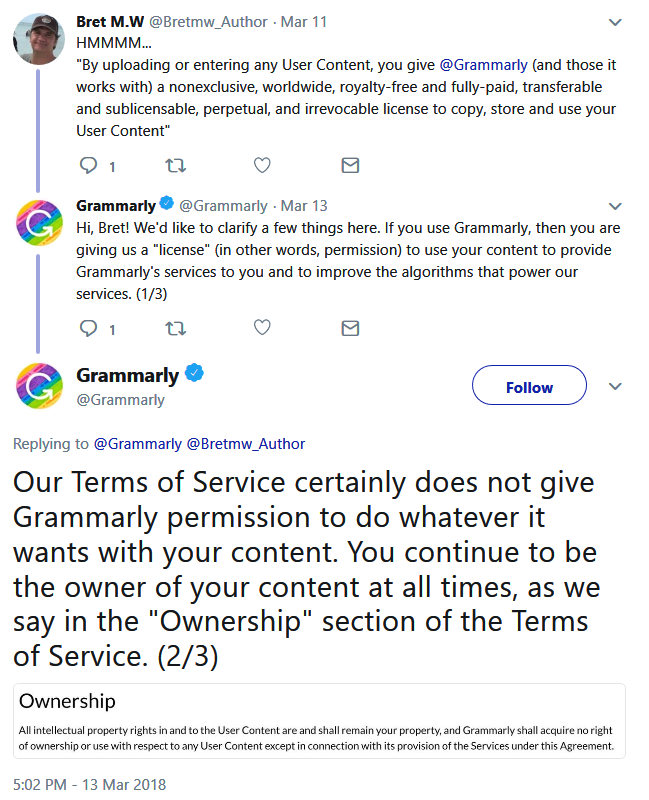
And instead they should be referring to this much more appropriate part from their "terms" page:

It is confusing what they mean by "Services" - they write that:
So they call "Services" to be "Services" - okay. The "without limitation" takes the cake. To be honest - I still don't know what exactly they mean by Services - except that it is "something that has no limits". It could be anything, like everything? Ask your attorney.
It is unclear why they would offer "human proofreading services" in the first place? Anyway.. will let myself take the best guess where those "editors" are located and whether they are native English speakers.
Also, check the misleading answers on their "Support" pages. Most unsuspecting users check the Q&A questions to get their "knowledge" - but the "knowledge" is a bunch of half-truths to make the user feel comfortable. Whatever is written on the Support or FAQ pages is meaningless from a legal viewpoint. What matters are the actual Terms of Service / Privacy pages.
For example:
Question and answer about Grammarly "Data":

Isn't it interesting why they specifically chose the word "data" when referring to "personal information"? According to Merriam-Webster, definition of DATA:
"information in digital form that can be transmitted or processed"
In the end, a casual reader would wrongly assume that "data" refers to both personal user / account information and the submitted content. The goal is for the reader to stop thinking and move on.
Question and answer about Grammarly "Who owns the checked content":
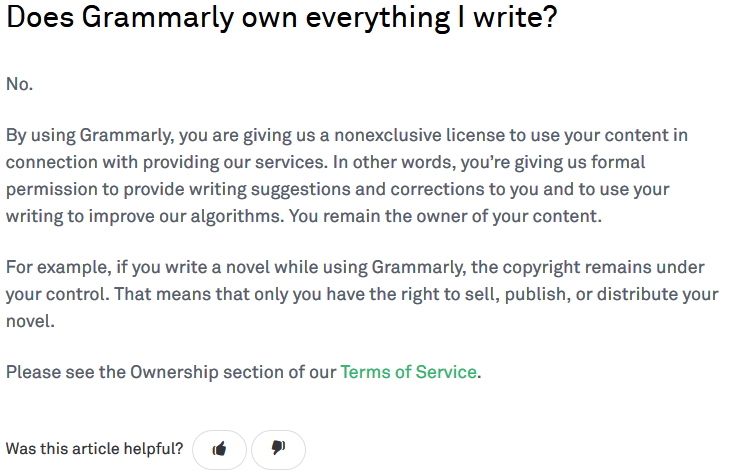
Here, again, the first paragraph states "No" (move on quickly, nothing to worry about). And the reply doesn't even answer the question. It intentionally focuses on "copyright" and mixes the words: ownership, copyright, license to make it appear like they are the same. By legal definitions, these are completely different words with different meanings. If they own a license to your work, they can do anything they want with your work, without your further approval. The most crucial part in this "answer" is reference to the Terms of Service -- because that's where the nice-feel wording ends.
When using Grammarly, you are NO LONGER an exclusive license owner of your content - you legally share the rights to your content with Grammarly and their partners. They can do with your content whatever they allow themselves to do in their changeable Terms of Service. Perpetually = Forever and with no further asking you. They asked you when you installed their software. If you use the software - you automatically agree to give away the rights to your content.
I also notice the software keeps asking you to create a "free" account when you install Grammarly in your web browser. Currently you can sign-in | create account via Gmail or Facebook. If you do:
- Grammarly get to know your email address and unique device ID associated with your email. Knowing your email address, email content, and unique device ID, they may find out who you are. Maybe not on the first day of using the tools but soon thereafter.
Question for 10 points: WHY does Grammarly would need to obtain this full crazy license to use your content? In public they claim that "without the license we would be unable to provide the services to you." HOWEVER, how is it possible that their competitors (not endorsing them either) who provide the same services DO NOT such a license at all? An example:
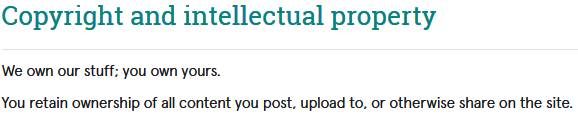
Could it be the answer to the puzzle - that they need the license because editing your grammar or spelling mistakes is just a tiny part of their operation. They would not create the company and invest millions to give you free service for nothing, would they. Only getting your content for free and using it as they and their partners please could be worthwhile.
And more about emails. Grammarly claims that they get this unlimited license to use and sell your content in order to provide the service. It's not true but that's another story. The issue is - what if the email content belongs to a person or organization that have not agreed to be bound by Grammarly terms? What if you receive an email that has the "This email is intended only for the recipient" confidentiality notice? If what they claim about "not being able to provide the service to those who haven't agreed to them" was true, they would exclude email content from copying and scanning. But they do and don't care about confidentiality notices.
Good luck with your grammar and word usage. If there are any real lawyers - in particular those who specialize in copyright, user content ownership, authorship, data storage, spyware, or privacy laws here -- feel free to correct me if I'm wrong. This is not a legal advice and this post was not checked by any plagiarism or text editing tool.
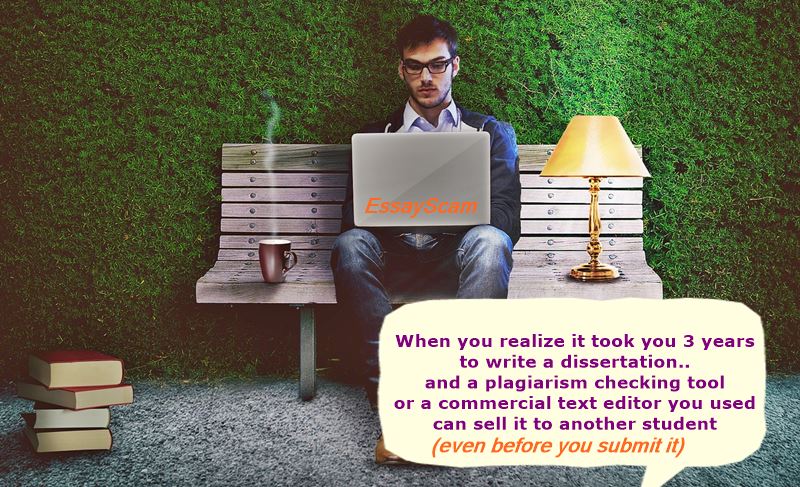
P.S. -- I have also checked the top 10 results in Google for the term: "Grammarly review". To be the most accurate, I opened the search page in a private | incognito mode. I wanted to exclude possible personalized results.
My conclusion - - most if not all of the top reviews are affiliate pages. Prominent online marketers publish content with links to the Grammarly affiliate program. When there is some action like sign-up or sale, the affiliate gets a cut.
As an affiliate, they usually don't try to write an unbiased review. Therefore they cannot be objective. They just want to make sales. That's why in their reviews they present and focus on features of the software -- not on things that really matter like privacy, terms of use, or content licensing. You can check for yourself - ZERO of the top 10 articles even mention the word "privacy" or "content ownership" in their "reviews".
Finally.. it truly makes you wonder who uses such tools. Are users of such software smart or reasonable people? Make your own guess, but to me they are not. I can understand students using such tools, but professionals - especially those who handle not their own or classified content, or produce content for their customers? It's indefensible and likely illegal. It's possible to spot those people on on social media as they select themselves from intelligent individuals. Two examples:
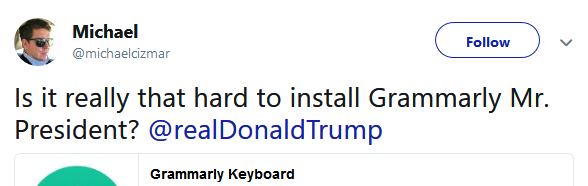
- They suggest prominent people like presidents, news organizations / reporters, artists, scientists, or lawyers should use the tool (who cares all written or edited content of president would be accessed in real time by undisclosed companies or even spy agencies in various countries), right?
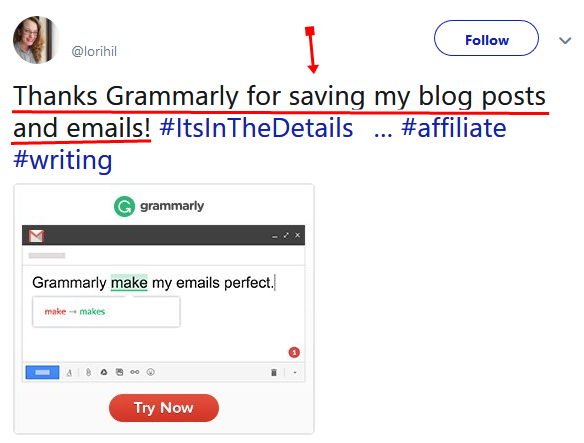
- Here is a gem - "Thanks Grammarly for SAVING my blog posts and emails!" - these people should be banned from life or from thinking out loud, shouldn't they.
Disclaimer - IANAL (I'm not a lawyer) -- readers should consult their own legal representatives to confirm or deny the findings presented in this post.
If something is "free" - you are the product. As far as plagiarism finding or content editing tools are concerned - you are not only the product but also the one who creates the product. You create content that can be indefinitely and commercially used by third parties. All with your approval.
Grammarly and their competitors that store user content save ALL content found in your web browser's text area. If you use a keyboard to enter or edit text and have Grammarly or related tools installed and enabled - they save this content in their databases. In real time.
Saving or storing content is not bad by itself. Free email accounts like Gmail, Yahoo, Outlook or word processing tools like Google Docs or Microsoft Office Online also save and store content. But the difference here is that by using Grammarly you give up exclusive rights to your content to Grammarly and its current | future partners. It is called "licensing". The license you give is: worldwide, royalty-free, transferable, perpetual, and irrevocable. By a non-legal language, when using Grammarly and similar tools:
- You give them away (no compensation to you) the right to "use" your content forever. "Use" means: copy, re|publish (not necessarily by them but through their current or future "partners"), resell.
- You are no longer an exclusive owner of your content. Technically, you continue owning the content BUT you legally share the rights to it with Grammarly and their partners.
User Content - What Can Happen to It?
In extreme scenarios, this is what COULD happen:
A) You write a 500-page long book. It took you 15 years to write it. Before publishing, you run it through Grammarly. Guess what - you've just licensed the book to Grammarly. Their business partners can take your ideas from it and publish it BEFORE you do, lol. They can make money on selling the book, even if you don't make a dollar on it.
B) You are a legal expert or work for the FBI. You have Grammarly installed. You have some crucial and secret piece of information in your email. You open your email and edit it using Grammarly. You dont even have to send it - draft messages are saved too. The content of the email is now stored on Grammarly servers. In the next presidential elections whoever subpoenaed Grammarly can access the message.
C) Your name is William Shakespeare Junior. Took you 40 years to write "Romeo and Juliet v.2.0." You check your grammar with Grammarly or their close competitor. They've just legally become your business partners. They are authorized to use your work and make profits on it - even if you never do. You continue to be the owner of the content but they have all the necessary legal permits to use it in any way they wish, as listed in their Terms of Use.
D) You write a computer code. 200K lines of code. It's a new cool video game available as an Android or iPhone app. You forgot to turn the "content check" off when you were improving the code in your code editing tool. Now it is saved and you may have gotten yourself a new business shareholder for the future.
E) You are a professional songwriter. Your job is to write lyrics for singers. You were lucky to write a hit song to be performed by a star. You run your lyrics through Grammarly or a plagiarism checking software. The song is saved and you've just gave up exclusive rights to use it. You license the song to a top music production group at 8% of revenues. You think it is going to make you a lot of money. A few weeks later the production group calls you to cancel the deal. The reason - they got a better deal from one of Grammarly's partners who owns the full permits to resell your lyrics - at 6%. Good luck fighting it in courts.
F) You are a scientist working on a new source of energy made of salt water. You become famous after media reported a video of your boat running 100% on salt water. A business partner of Grammarly really wants to know the secret. We don't know who their partners are and where they are located. It could bring them millions. They have managed to find out your personal email. You authenticate Grammarly using your Facebook or personal email account. Now Grammarly can scan all content used with the service and associated with this email. They don't have to search millions of documents that mention "salt water" or "boat". They can legally target you and become your business partners. They can use their perpetual license to your invention secrets as they see fit.
These may be a paranoiac person examples that could never materialize, but when you work on something really hard for a long time, you may want to be extra careful.
From what I can tell Grammarly uses Amazon AWS servers to provide the service. They claim to store user content in the United States (that is technically true). But could they also have a copy of the databases in their Ukrainian offices? They don't specifically confirm or deny - so they could or could not. You may ask. However, keep in mind their Terms, database locations, and business affiliations may change at any time.
There is very interesting information posted by a global corporate attorney about privacy and terms of Grammarly.
A corporate lawyer's opinion, quote:
That means that if you use Grammarly, instead of your own brain or a copy editor, you are no longer the exclusive owner of your content.
sheownsit.com/may-not-enjoy-grammar-worth-giving-away-content-legallysavvysbo/
Its fun to read the article and comments. Some of them are hilarious or misleading by intention. Most people - even when they claim to be lawyers - dont understand the difference between content ownership and content licensing. In essence - you can do whatever you want with the content if you have proper license to use it. You DO NOT have to own the content to resell it, republish it, rewrite it, or sub-license it. That's the legal definition of content licensing. Too many people - students in particular - cannot get it to their heads, but it is that simple.
Some users on social media get suspicious about the whole privacy, software access and permissions, and content usage thing. But when they ask Grammarly questions about licensing they get an answer about "content ownership". I believe it is an intentional response as they always post the same answer and include only a part of a screenshot discussing "who owns the user content". See below.
And instead they should be referring to this much more appropriate part from their "terms" page:
It is confusing what they mean by "Services" - they write that:
.. Grammarly, Inc. makes available "Services" (including, without limitation, writing feedback suggestions and/or corrections, plagiarism detection, and human proofreading services) to help people communicate more effectively.
So they call "Services" to be "Services" - okay. The "without limitation" takes the cake. To be honest - I still don't know what exactly they mean by Services - except that it is "something that has no limits". It could be anything, like everything? Ask your attorney.
It is unclear why they would offer "human proofreading services" in the first place? Anyway.. will let myself take the best guess where those "editors" are located and whether they are native English speakers.
Confusing Support Pages Questions & Answers
Also, check the misleading answers on their "Support" pages. Most unsuspecting users check the Q&A questions to get their "knowledge" - but the "knowledge" is a bunch of half-truths to make the user feel comfortable. Whatever is written on the Support or FAQ pages is meaningless from a legal viewpoint. What matters are the actual Terms of Service / Privacy pages.
For example:
Question and answer about Grammarly "Data":
Isn't it interesting why they specifically chose the word "data" when referring to "personal information"? According to Merriam-Webster, definition of DATA:
"information in digital form that can be transmitted or processed"
In the end, a casual reader would wrongly assume that "data" refers to both personal user / account information and the submitted content. The goal is for the reader to stop thinking and move on.
Question and answer about Grammarly "Who owns the checked content":
Here, again, the first paragraph states "No" (move on quickly, nothing to worry about). And the reply doesn't even answer the question. It intentionally focuses on "copyright" and mixes the words: ownership, copyright, license to make it appear like they are the same. By legal definitions, these are completely different words with different meanings. If they own a license to your work, they can do anything they want with your work, without your further approval. The most crucial part in this "answer" is reference to the Terms of Service -- because that's where the nice-feel wording ends.
When using Grammarly, you are NO LONGER an exclusive license owner of your content - you legally share the rights to your content with Grammarly and their partners. They can do with your content whatever they allow themselves to do in their changeable Terms of Service. Perpetually = Forever and with no further asking you. They asked you when you installed their software. If you use the software - you automatically agree to give away the rights to your content.
I also notice the software keeps asking you to create a "free" account when you install Grammarly in your web browser. Currently you can sign-in | create account via Gmail or Facebook. If you do:
- Grammarly get to know your email address and unique device ID associated with your email. Knowing your email address, email content, and unique device ID, they may find out who you are. Maybe not on the first day of using the tools but soon thereafter.
Question for 10 points: WHY does Grammarly would need to obtain this full crazy license to use your content? In public they claim that "without the license we would be unable to provide the services to you." HOWEVER, how is it possible that their competitors (not endorsing them either) who provide the same services DO NOT such a license at all? An example:
Could it be the answer to the puzzle - that they need the license because editing your grammar or spelling mistakes is just a tiny part of their operation. They would not create the company and invest millions to give you free service for nothing, would they. Only getting your content for free and using it as they and their partners please could be worthwhile.
And more about emails. Grammarly claims that they get this unlimited license to use and sell your content in order to provide the service. It's not true but that's another story. The issue is - what if the email content belongs to a person or organization that have not agreed to be bound by Grammarly terms? What if you receive an email that has the "This email is intended only for the recipient" confidentiality notice? If what they claim about "not being able to provide the service to those who haven't agreed to them" was true, they would exclude email content from copying and scanning. But they do and don't care about confidentiality notices.
Good luck with your grammar and word usage. If there are any real lawyers - in particular those who specialize in copyright, user content ownership, authorship, data storage, spyware, or privacy laws here -- feel free to correct me if I'm wrong. This is not a legal advice and this post was not checked by any plagiarism or text editing tool.
P.S. -- I have also checked the top 10 results in Google for the term: "Grammarly review". To be the most accurate, I opened the search page in a private | incognito mode. I wanted to exclude possible personalized results.
My conclusion - - most if not all of the top reviews are affiliate pages. Prominent online marketers publish content with links to the Grammarly affiliate program. When there is some action like sign-up or sale, the affiliate gets a cut.
As an affiliate, they usually don't try to write an unbiased review. Therefore they cannot be objective. They just want to make sales. That's why in their reviews they present and focus on features of the software -- not on things that really matter like privacy, terms of use, or content licensing. You can check for yourself - ZERO of the top 10 articles even mention the word "privacy" or "content ownership" in their "reviews".
Finally.. it truly makes you wonder who uses such tools. Are users of such software smart or reasonable people? Make your own guess, but to me they are not. I can understand students using such tools, but professionals - especially those who handle not their own or classified content, or produce content for their customers? It's indefensible and likely illegal. It's possible to spot those people on on social media as they select themselves from intelligent individuals. Two examples:
- They suggest prominent people like presidents, news organizations / reporters, artists, scientists, or lawyers should use the tool (who cares all written or edited content of president would be accessed in real time by undisclosed companies or even spy agencies in various countries), right?
- Here is a gem - "Thanks Grammarly for SAVING my blog posts and emails!" - these people should be banned from life or from thinking out loud, shouldn't they.
Disclaimer - IANAL (I'm not a lawyer) -- readers should consult their own legal representatives to confirm or deny the findings presented in this post.