Jan 24, 2014 | #1
In recent weeks, I've been studying SEO (search engine optimization) in more detail in the context of online writing, editing, and research services. Here are the results of my research which may be practical to genuine freelance writers, academic paper writing services, and all other kinds of online businesses. I realize this post will also be read by people who are actively engaged in sabotaging of their competition, but now they may at least stop fooling themselves that they act under the radar.
NEGATIVE SEO ATTACK - THE IDEA
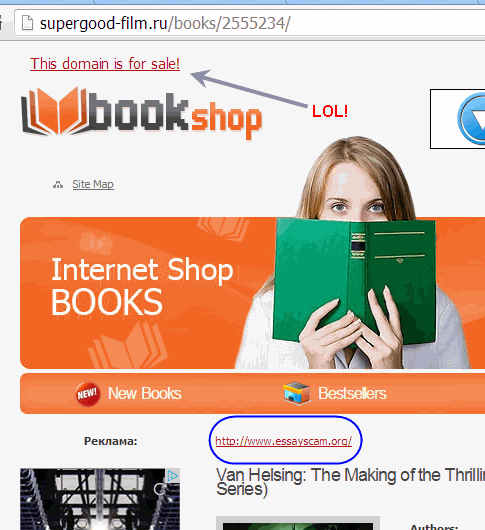
There is an ongoing threat from rogue companies and/or individuals who become involved in fraudulent cyber activates called "negative SEO attacks." The attackers usually try to sabotage websites that they are unable to compete against in normal circumstances. The goal of a negative SEO attack is to trigger a search engine penalty (either manual or algorithmic). Once a website is marked as penalized, it loses organic search engine traffic which may have very negative consequences for the business.
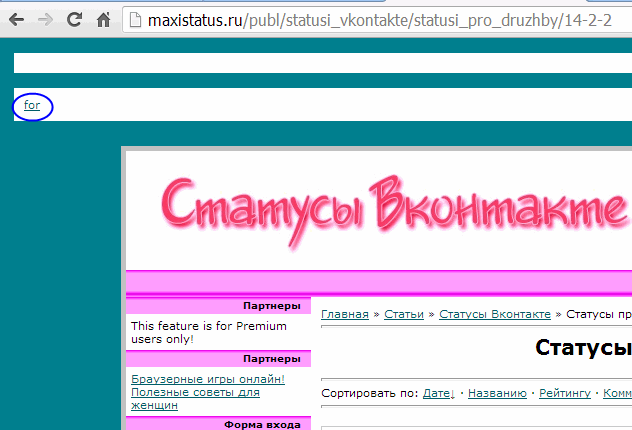
 A typical negative SEO attack of a writing service website takes up to a few weeks. It involves creating a massive amount of unnatural links and pointing them to the attacked website. The anchor text (the keywords used in a link) of the inbound links is usually closely related to the website's theme in the hopes of covering up the operation and creating confusion. In general, the attackers hope that search engines will penalize a website that has obtained hundreds or thousands of unnatural links. At first sight, the links may look "natural" because the anchor text is actually related to the website's theme which may initially suggest that the website owner was the one who acquired the links. However, the fact that the links are usually published on low-quality and spammy websites (including foreign ones) that have little to do with the attacked website's theme is a good indication that it is, in fact, sabotage.
Obviously, Google and Bing aren't able to determine who is/was behind building the damaging links. There is so much spam on the Internet that, as a general rule, it has been safe to assume that it's usually the website owner who - willingly or unwillingly - does the damage to their own site. However, that's not always the case, especially in the last couple of years when the negative SEO trend against writing and research services has been on the rise.
Fortunately, thanks to Google's and Bing's efforts and the raising awareness of the "white hat" SEO community, there are now established and successful ways of dealing with a negative SEO attack against a writing service.
NEGATIVE SEO ATTACK - THE SOLUTIONS
Since it is impossible to control who links to your site, the most important aspect of the solution is to monitor the quality and quantity of backlinks pointed to your website. Both Google: google.com/webmasters/ and Bing: bing.com/toolbox/webmaster offer Webmaster Tools where you can add your website and monitor backlink activities. There are also some commercial link monitoring tools that usually work faster and are more accurate than general search engine spiders.
When you notice unnatural links pointed to your website or when there is a manual or algorithmic penalty against your website, Google and Bing suggest to first contact webmasters of websites that link to your site and ask them to remove the spammy/low-quality/unnatural links. Contacting other webmasters may be time-consuming and not always very successful, but it is usually worth the effort because removing each link means one problem less. It often happens that the actual website owners aren't aware of the fraudulent activities going on their own websites due to the fact that many of them outsource web development / SEO to other companies or individuals who abuse their power. If your site received a manual penalty notice, it is important that you document your link removing efforts in a separate text or spreadsheet file because this document may be needed and helpful when you submit a reinclusion/reconsideration request.
If your website has hundreds or thousands of bad links pointed to your site, it will not be possible to remove them all by contacting webmasters. In that case, you will have to use a Disavow Tool (offered both by Google and Bing). The Disavow Tool was designed to "neutralize" toxic backlinks. It is fairly simple to use. All you need to do is to collect bad URLs and/or domains and include them (each in a separate line) in a disavow.txt file.
For example, if you want to disavow this sample URL:
somebadwebsite.com/malicious-link-page.php,
you just copy-paste it to the text file; in consequence, all bad links posted on this particular web page will be "neutralized." However, in most cases, it is safer to disavow the whole domain or subdomain because that way you don't have to worry about any other bad links that may be published in the future on the same domain. In order to disavow the whole domain or subdomain, you need to add the following in the disavow text file:
domain: somebadwebsite.com (# for domains)
domain: subdomain.somebadwebsite.com (# for subdomains)
There is an extremely handy and free tool that can make the process of creating a disavow file simple: https://urltodomain.com/.
Once you've created a disavow.txt file, you need to upload it to your Webmaster Tools - Google: google.com/webmasters/tools/disavow-links-main, Bing: bing.com/webmaster/help/how-to-disavow-links-0c56a26f. After that, it is a very good practice to continue monitoring your backlinks and if you find more attacking URLs or domains, you need to upload a new disavow file (important: do not delete any previously uploaded URLs or domains from the newly uploaded file).
If your website received a manual penalty notice or if you think there's something wrong about its organic rankings, you may file a reconsideration request (Google: google.com/webmasters/tools/reconsideration, Bing: support.microsoft.com/en-us). It should be done after you contacted other webmasters to remove bad links and/or uploaded the disavow tool to your Webmaster Tools account.
Depending on the situation, it may take between a few days and up to a few weeks to receive a reply from Google or Bing. The first reply may not always be positive; if that's the case, you need to repeat the process (this time try to be more detail-oriented) and file a reconsideration request again. On the other hand, it is believed that the URLs or domains submitted through the disavow file are working much sooner towards your website's recovery success.
Apart from disavowing links you are not responsible for, there's an additional way of "disinfecting" bad links. It requires access to a .htaccess file (this file needs to be created and uploaded to the website's main directory, usually called "public_html"). Using the urltodomain.com tool, you can create a HTTP_REFERER list of domains that you don't want to have anything to do with and paste it into your .htaccess file. That way you will deny access to all links posted on bad domains or subdomains (ie. such backlinks should not work against your website because they should not be counted as valid links)
-----------------
The ideas and steps described above should make all writing, editing, and research service owners aware of the actions going on behind the scenes that may negatively impact their online service or any other business. The provided solutions should help them recover or improve the recovery process of their websites and increase their visibility in search engines. I hope legitimate readers of this forum: honest freelance writers, new or established research services, essay editors, students, and other companies will find this post helpful and informative. By now they should know how to successfully fight back against the malicious practices of those who turn to dishonest and fraudulent search engine manipulation activities.
NEGATIVE SEO ATTACK - THE IDEA
There is an ongoing threat from rogue companies and/or individuals who become involved in fraudulent cyber activates called "negative SEO attacks." The attackers usually try to sabotage websites that they are unable to compete against in normal circumstances. The goal of a negative SEO attack is to trigger a search engine penalty (either manual or algorithmic). Once a website is marked as penalized, it loses organic search engine traffic which may have very negative consequences for the business.
A typical negative SEO attack of a writing service website takes up to a few weeks. It involves creating a massive amount of unnatural links and pointing them to the attacked website. The anchor text (the keywords used in a link) of the inbound links is usually closely related to the website's theme in the hopes of covering up the operation and creating confusion. In general, the attackers hope that search engines will penalize a website that has obtained hundreds or thousands of unnatural links. At first sight, the links may look "natural" because the anchor text is actually related to the website's theme which may initially suggest that the website owner was the one who acquired the links. However, the fact that the links are usually published on low-quality and spammy websites (including foreign ones) that have little to do with the attacked website's theme is a good indication that it is, in fact, sabotage.Obviously, Google and Bing aren't able to determine who is/was behind building the damaging links. There is so much spam on the Internet that, as a general rule, it has been safe to assume that it's usually the website owner who - willingly or unwillingly - does the damage to their own site. However, that's not always the case, especially in the last couple of years when the negative SEO trend against writing and research services has been on the rise.
Fortunately, thanks to Google's and Bing's efforts and the raising awareness of the "white hat" SEO community, there are now established and successful ways of dealing with a negative SEO attack against a writing service.
NEGATIVE SEO ATTACK - THE SOLUTIONS
Since it is impossible to control who links to your site, the most important aspect of the solution is to monitor the quality and quantity of backlinks pointed to your website. Both Google: google.com/webmasters/ and Bing: bing.com/toolbox/webmaster offer Webmaster Tools where you can add your website and monitor backlink activities. There are also some commercial link monitoring tools that usually work faster and are more accurate than general search engine spiders.
When you notice unnatural links pointed to your website or when there is a manual or algorithmic penalty against your website, Google and Bing suggest to first contact webmasters of websites that link to your site and ask them to remove the spammy/low-quality/unnatural links. Contacting other webmasters may be time-consuming and not always very successful, but it is usually worth the effort because removing each link means one problem less. It often happens that the actual website owners aren't aware of the fraudulent activities going on their own websites due to the fact that many of them outsource web development / SEO to other companies or individuals who abuse their power. If your site received a manual penalty notice, it is important that you document your link removing efforts in a separate text or spreadsheet file because this document may be needed and helpful when you submit a reinclusion/reconsideration request.
If your website has hundreds or thousands of bad links pointed to your site, it will not be possible to remove them all by contacting webmasters. In that case, you will have to use a Disavow Tool (offered both by Google and Bing). The Disavow Tool was designed to "neutralize" toxic backlinks. It is fairly simple to use. All you need to do is to collect bad URLs and/or domains and include them (each in a separate line) in a disavow.txt file.
For example, if you want to disavow this sample URL:
somebadwebsite.com/malicious-link-page.php,
you just copy-paste it to the text file; in consequence, all bad links posted on this particular web page will be "neutralized." However, in most cases, it is safer to disavow the whole domain or subdomain because that way you don't have to worry about any other bad links that may be published in the future on the same domain. In order to disavow the whole domain or subdomain, you need to add the following in the disavow text file:
domain: somebadwebsite.com (# for domains)
domain: subdomain.somebadwebsite.com (# for subdomains)
There is an extremely handy and free tool that can make the process of creating a disavow file simple: https://urltodomain.com/.
Once you've created a disavow.txt file, you need to upload it to your Webmaster Tools - Google: google.com/webmasters/tools/disavow-links-main, Bing: bing.com/webmaster/help/how-to-disavow-links-0c56a26f. After that, it is a very good practice to continue monitoring your backlinks and if you find more attacking URLs or domains, you need to upload a new disavow file (important: do not delete any previously uploaded URLs or domains from the newly uploaded file).
If your website received a manual penalty notice or if you think there's something wrong about its organic rankings, you may file a reconsideration request (Google: google.com/webmasters/tools/reconsideration, Bing: support.microsoft.com/en-us). It should be done after you contacted other webmasters to remove bad links and/or uploaded the disavow tool to your Webmaster Tools account.
Depending on the situation, it may take between a few days and up to a few weeks to receive a reply from Google or Bing. The first reply may not always be positive; if that's the case, you need to repeat the process (this time try to be more detail-oriented) and file a reconsideration request again. On the other hand, it is believed that the URLs or domains submitted through the disavow file are working much sooner towards your website's recovery success.
Apart from disavowing links you are not responsible for, there's an additional way of "disinfecting" bad links. It requires access to a .htaccess file (this file needs to be created and uploaded to the website's main directory, usually called "public_html"). Using the urltodomain.com tool, you can create a HTTP_REFERER list of domains that you don't want to have anything to do with and paste it into your .htaccess file. That way you will deny access to all links posted on bad domains or subdomains (ie. such backlinks should not work against your website because they should not be counted as valid links)
-----------------
The ideas and steps described above should make all writing, editing, and research service owners aware of the actions going on behind the scenes that may negatively impact their online service or any other business. The provided solutions should help them recover or improve the recovery process of their websites and increase their visibility in search engines. I hope legitimate readers of this forum: honest freelance writers, new or established research services, essay editors, students, and other companies will find this post helpful and informative. By now they should know how to successfully fight back against the malicious practices of those who turn to dishonest and fraudulent search engine manipulation activities.