Jun 12, 2016 | #1
I recently came across an essay, "An apple a day keeps the Flexowriter away" by William K. Zinsser (his real name) (Horizon, August 1967, p. 120) that poked fun at doctors who were using Flexowriters to personalize letters to patients (which also reminded them their bills were due). This essay made me laugh for a couple of reasons, but most especially because I actually used a Flexowriter in Southeast Asia back in the early 1970s. .
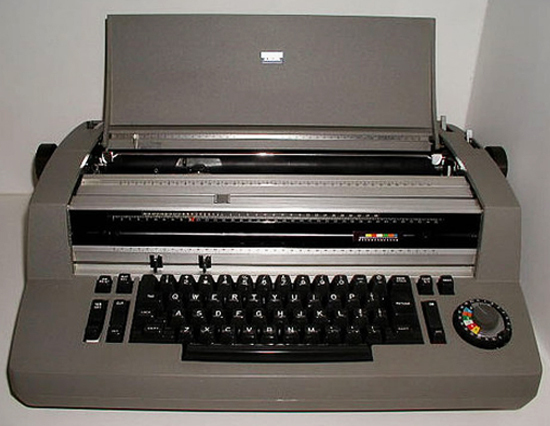
The first commercially successful typewriter was invented around 1870 and 50 years later, the Friden Flexowriter was introduced which made it possible to record a series of keystrokes on paper tape using 5 to 7 punched holes and then to play these codes back through a reader (at left of keyboard) to retype the same text repeatedly.
This was a real breakthrough for overworked Army personnel such as myself and I welcomed it with open arms. The Flexowriter, though, was engineered with all of the latest state-of-the-art sound-dampening technology, which meant it was only slightly louder than an out-of-alignment steam engine twice its size. The machine also tended to vibrate and would actually shake anyone sitting or standing nearby. When running full blast in a confined office, the effect was truly unsettling. (A proportional spaced version of the Flexowriter known as "The Presidential" was used during World War II by the president to personalize letters notifying next of kin of the deaths of military personnel. Although I never used one of these, I did use a proportional spaced IBM Selectric typewriter in Korea that was invented (and apparently serviced) by Satan himself, but that's a story for another time.)
In 1970 as I was complaining one day about the noise and hassle involved in operating the Flexowriter and suggesting that there must be a better way, a captain recently assigned to the Pentagon assured me that there not only was a better way, word processors were already being used at Department of the Army headquarters. Word processors and then personal computers, of course, doomed the Flexowriter and even memory typewriters in short order and it only took 100 years.
The essay by Zinsser (his real name) made me think that we'll be looking back on our current IT that we are so proud of 50 years from now and regarding it much like we view the ugly duckling Flexowriter today. I wonder what it will be like then. I'm betting there will still be no flying cars but there will be plenty of consumer robots and Americans will still own lots of guns.
The first commercially successful typewriter was invented around 1870 and 50 years later, the Friden Flexowriter was introduced which made it possible to record a series of keystrokes on paper tape using 5 to 7 punched holes and then to play these codes back through a reader (at left of keyboard) to retype the same text repeatedly.
This was a real breakthrough for overworked Army personnel such as myself and I welcomed it with open arms. The Flexowriter, though, was engineered with all of the latest state-of-the-art sound-dampening technology, which meant it was only slightly louder than an out-of-alignment steam engine twice its size. The machine also tended to vibrate and would actually shake anyone sitting or standing nearby. When running full blast in a confined office, the effect was truly unsettling. (A proportional spaced version of the Flexowriter known as "The Presidential" was used during World War II by the president to personalize letters notifying next of kin of the deaths of military personnel. Although I never used one of these, I did use a proportional spaced IBM Selectric typewriter in Korea that was invented (and apparently serviced) by Satan himself, but that's a story for another time.)
In 1970 as I was complaining one day about the noise and hassle involved in operating the Flexowriter and suggesting that there must be a better way, a captain recently assigned to the Pentagon assured me that there not only was a better way, word processors were already being used at Department of the Army headquarters. Word processors and then personal computers, of course, doomed the Flexowriter and even memory typewriters in short order and it only took 100 years.
The essay by Zinsser (his real name) made me think that we'll be looking back on our current IT that we are so proud of 50 years from now and regarding it much like we view the ugly duckling Flexowriter today. I wonder what it will be like then. I'm betting there will still be no flying cars but there will be plenty of consumer robots and Americans will still own lots of guns.