Although I would never go back, I realize now that I miss typewriters. I don't miss having to manually center things, the P.I.T.A. error corrections with an eraser* and piece of cardboard (especially with half a dozen carbon copies) or the stuck keys, but I do miss the sounds of manual keys being struck, slamming the carriage back at the end of a line in a manly fashion (this was especially gratifying) and the hearing the carriage return bell which signaled progress.
It turns out that others feel this way as well. For instance, one blogger, "Manoj," tells us that, "There's something about the sound that a typewriter makes, when you, type-write; a kind of a... therapeutic value associated with the sounds of those keystrokes." A number of apps have been developed to make your keyboard sound like a typewriter, including:
Noisy Typer: fffff.at/noisy-typer-a-typewriter-for-your-laptop/
Typewriter Keyboard: alphaomega.software.free.fr/typewriterkeyboard/Typewriter%20Keyboard.html
among others listed at indefiniteloop.com/blog/resource/typewriter-keyboard-make-your-keyboard-sound-like-a-typewriter.html
I think I'll give these a try.
___________________
While attending a multi-service stenography school at Ft. Ben Harrison, Indiana (I don't think this place is even there anymore), our 84-year-old typing teacher, Mrs. Johnson, assured us that we could erase anything -- even a period. It turns out this is not true.
And... here's the story.
After being sent to Bangkok on temporary duty to learn how to use an IBM Mag Card I in 1970 and being warned by my commander to not "blow off these classes and spend your time sightseeing," my wife and I spent our time sightseeing Bangkok* after I spent one morning at IBM Headquarters learning how to use this system. No sweat. I never had a chance to demonstrate my newly acquired skills because the Thais stole the typewriter (but not the console - duh) the day after we received it. Things got a little more complicated after that. At my next post, they learned I was one of the few people in the U.S. Army trained on this machine, but the IBM Mag Card I was far different from the less user-friendly versions that would be foisted upon us soon -- most especially proportionately spacing.
According to the Wikipedia entry: "In 1972, the 'Mag Card Executive' was offered. Like IBM's earlier typebar-based 'Executive' models this offered proportional spacing, based on multiples of a 1/60" unit size. Unlike the various 'Selectric Composer'* models, there was no provision for setting the machine to vary the letter and word spacing to create justified copy."
For those of you born after 1980 and have never seen anyone actually use a typewriter (and as mentioned above), this typewriter was an innovation by Satan himself. Just try backspacing to correct a mistake (something most of you have never experienced with non-digital mechanisms) and watch the machine randomly select how many spaces. It was impossible but you had to try to persevere with the tools you had available -- so I tried. "Multiples of 1/60 unit size" my ass -- this machine was evil.
__________________
* This was GREAT!
** I owned one of these as well - next story!
Well, this EssayScam post (essayscam.org/clean-text/) made me feel old(er):
"Are you old enough to have learned how to type on a manual or electric typewriter? Probably not. They've become tools of the past, replaced by dedicated word processing equipment, then personal computers."
'Selectric Composer' ... next story
:
For those of you who are spoiled by the enormous variety of typefaces and sizes readily available today in any word processing program, this machine was obsolete before it was invented. It was, though, state-of-the-art during its day. According to the Wikipedia entry for this unique machine, "In 1966, IBM released the Selectric Composer. This highly modified (and much more expensive) Selectric produced camera-ready justified copy using proportional fonts in a variety of font styles from 8 points to 14 points." An IBM Selectric Composer is depicted in the figure below.
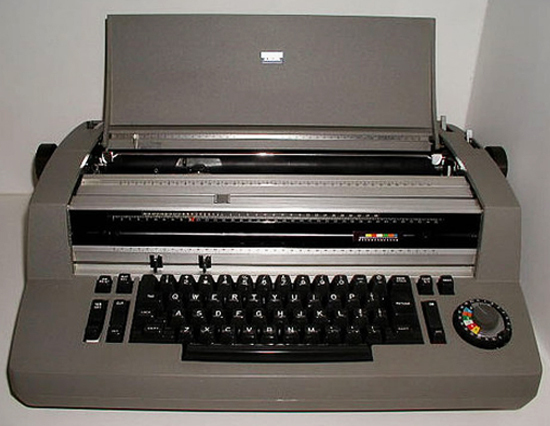
In 1977, I purchased a used Composer with about a dozen different typing elements commonly referred to as "balls" which replaced the standard keys in use at the time. Given my experiences with IBM's proportional-spaced predecessors, you'd think I know better but alas, I had faith in the technology. In truth, though, using this machine was tantamount to operating a Daguerreotype: "Material prepared on a properly adjusted machine by a skillful operator and printed onto baryta (barium sulfate-coated) paper would take an expert to tell... [that it] was not the product of a Linotype or Monotype machine." Big deal. Wait 10 years and everything changed and the "skillful operators" soon found themselves out of work. Progress, but at a cost.
50 years from now ... I'm betting there will still be no flying cars
I stand corrected. Sitting here thinking about drones (it happens), I wondered why they couldn't be made large enough to carry humans and lo and behold, that's exactly what researchers are doing now. See: youtube.com/watch?v=VfcZsyhUJ48 and cnn.com/videos/cnnmoney/2016/01/18/ehang-human-drone-prototype.cnn among others. Back in the 1960s, we all knew that marijuana would be legal and there would be flying cars someday, but I never thought I'd live to see either (the fall of the Berlin Wall or the collapse of the Soviet Union either, for that matter)..

